
Environmental Design
How a Lighthouse Campus Works
Inside a Lighthouse campus
A modern data center campus is six distinct systems, each with major design decisions affecting the community, environment, and grid. The campus includes low-rise buildings, utility yards, access roads, and support spaces. All six systems exist to keep the server rooms running.
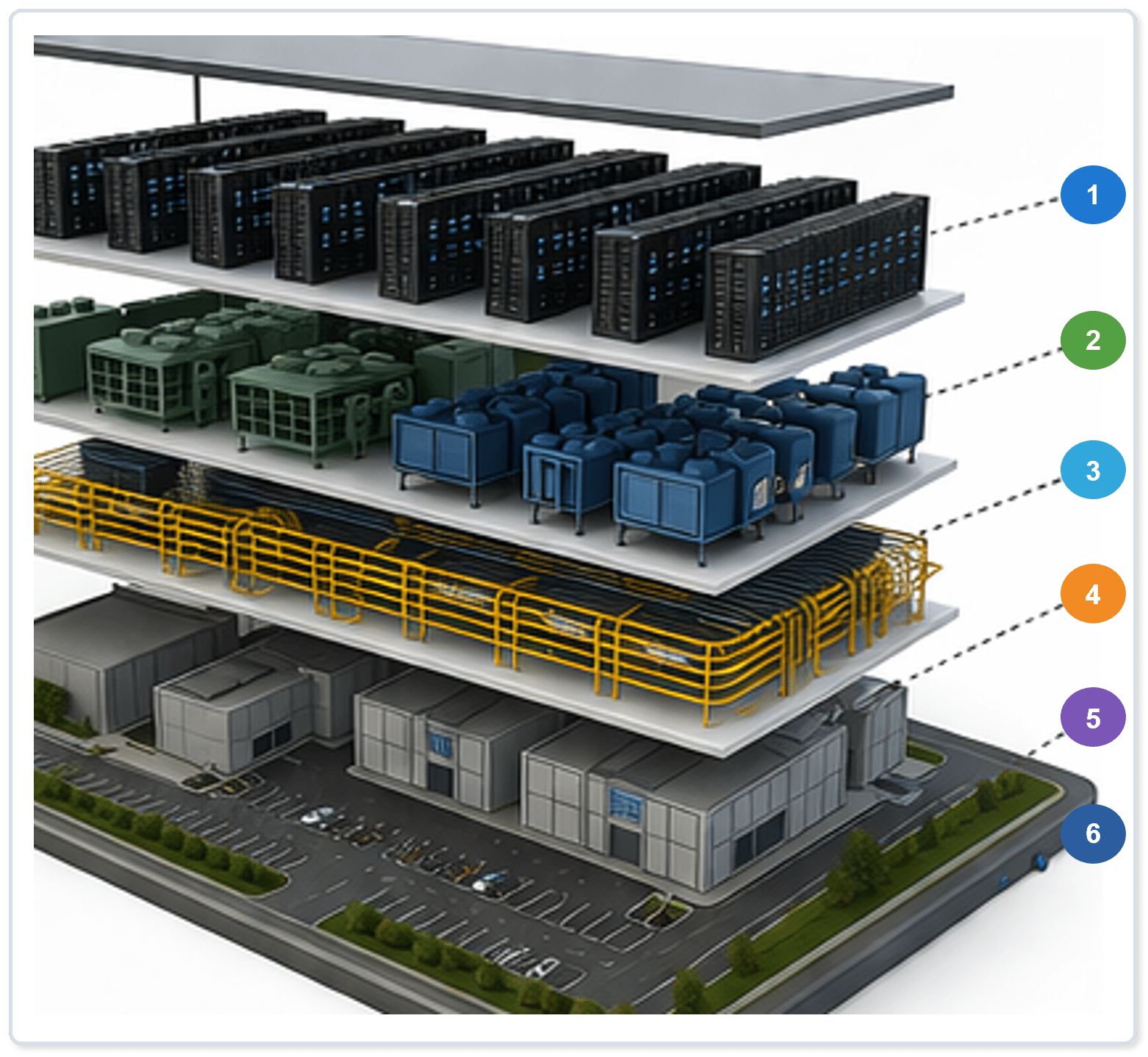
Exploded view
The six main parts of a data center, shown as separate layers.
- IT halls (server rooms) Rows of cabinets that hold the computers
- Power systems Grid power, on-site batteries, and backup systems
- Cooling systems Equipment that removes heat from the servers
- Network systems Fiber paths and switches that connect the site
- Support buildings Loading, workshops, offices, and security rooms
- Site infrastructure Roads, ponds, parking, fencing, and service yards
The site and buildings support the technical systems. All of them exist to keep the server rooms running.
Cleaning up and greening the data center industry
Every project is evaluated against four non-negotiable criteria. If a site, a partner, or a commercial structure requires compromising any one of them, we walk away.
1
Affordability
Smartly structured power agreements will lower electricity costs for the entire community. Plus, tax revenue from the data center will reduce local tax burdens.2
Environment
Carbon-neutral operations with new renewable power supply and minimal ongoing water use for cooling using a closed-loop system and careful siting rules.
3
Sustainability
Measurable protections for water, air, climate, and neighborhood character, verified from the onset of project planning through development and operations.